

Nine days, more than 500 official activities, dozens of simultaneous stages, concerts in Abandoibarra and Europa Park, fireworks, txosnas, street theatre and more than 1.5 million people filling the streets of Botxo.
Bilbao’s Aste Nagusia is a major festive and cultural event. However, year after year, locals and especially visitors face the same dilemma: where can I find the program?
Traditional brochures are hard to find, end up crumpled, or are sold out by the second day; 20-page PDFs are impossible to navigate with a mobile phone in hand amidst the crowd; and mobile applications accumulate problems: 100 MB downloads with saturated networks, unnecessary permissions, and obsolescence a few days after the festival ends.
In this edition, we have put Xabia AI technology to the test to create the world’s first truly intelligent, conversational, multilingual, and real-time party program .
Information about a major event is a living organism.
An urban festival is not static. A schedule change due to rain, a surprise concert at a festival tent, a last-minute guest artist, or a cancellation can make information from any print media or traditional website outdated.
The user wants immediate answers to real questions:
- “What time do the fireworks start?”
- “Norekin jotzen du Zea Maysek gaur eta zein ordutan?”
- ” Quali concerti ci sono oggi all’Arenal? “
- “Where can I find things to do in Bilbao with my grandparents?”

To answer this in milliseconds, cost-effectively and with 0% hallucinations , we have used the Xabia Ai architecture, designed to operate at massive scale without friction.
With Xabia AI, the program is not only on the web, it’s up to date.
Under the hood: RAG’s real-time sources and architecture
To ensure that the assistant (embodied in Marija-AI ) knew everything that was happening in Bilbao in real time, we developed a continuous ingestion and processing engine:
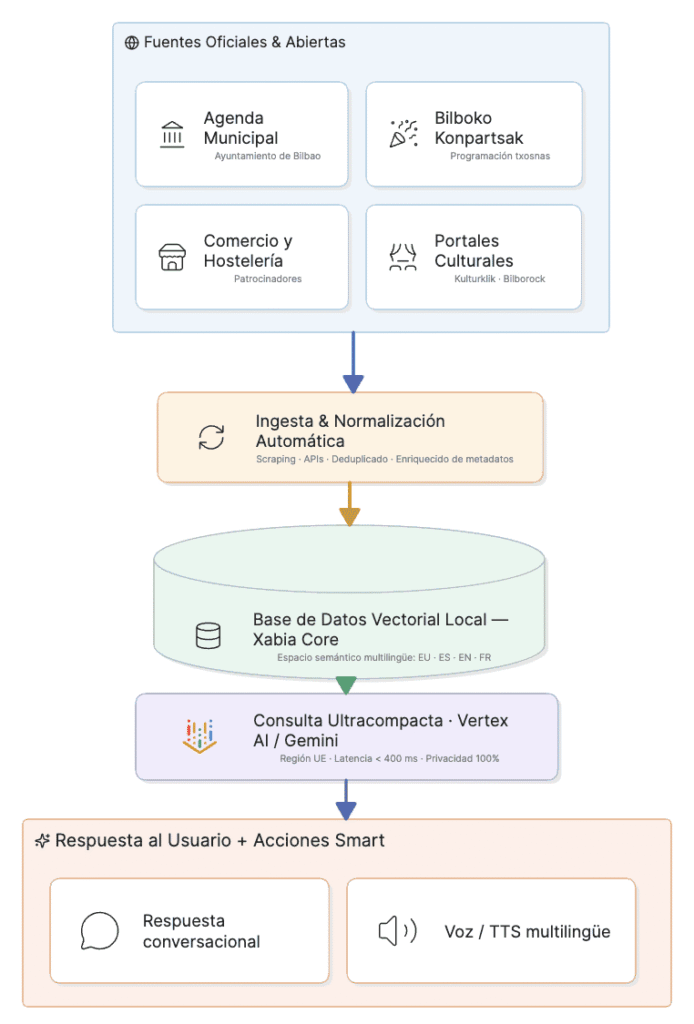
Sources: multichannel ingestion and continuous updating
The system ingests and structures heterogeneous sources : the municipal agenda, the press releases of the carnival groups, the theater listings and a series of other public sources.
Each event is broken down into contextual metadata : location, type of audience (family, night, children, gastronomy), accessibility and thematic tags.
RAG 100% local and multilingual
Unlike traditional machine translators that slow down the response, Xabia Ai operates in a native multilingual vector space .
The intent is understood directly whether it is formulated in Basque, Spanish, English, French, or German . Context search occurs within the local server in microseconds , isolating the data and ensuring that the AI only responds with verified information.

From pocket to street: touch totems, Smart QR codes and other media
Xabia AI’s great competitive advantage is its invisible and ubiquitous nature: it does not require downloading any app , it works directly in the standard web browser through Web Audio and Web Speech APIs.
To bring this experience to the physical city, Xabia Ai offers three layers of direct contact . In this large-scale user test, we used a sample of just over 5,000 queries to the virtual assistant.
Some of the visitor touchpoints offered by Xabia Ai in open public spaces are:
1. Smart QR codes on street furniture and signage
Smart QR codes are easily integrated into advertising on bus shelters, posters, or stickers at bus stops, metro stations, brochures, food and drink stalls, and bars. A simple scan with a mobile phone camera opens the interface in less than 0.8 seconds , ready for speaking or typing.
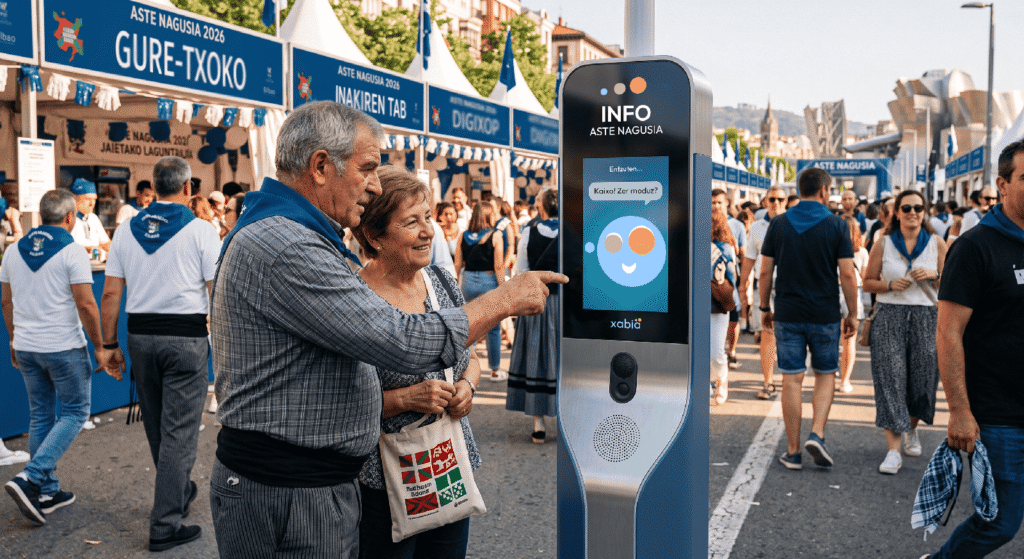
2. Interactive voice totems at key points
Simple assistance kiosks can be installed in high-traffic areas (Plaza Circular, Arenal, Plaza Nueva, and Abandoibarra). These high-visibility screens with directional microphones allow anyone—including the elderly or those with visual impairments—to approach and ask questions directly by voice without having to touch any buttons.
Xabia remains listening , is able to follow the conversation in any language with the interlocutor and start with a clean memory when the user says goodbye or leaves the conversation for the time interval indicated to the totem (for example, after 10 seconds without interaction).
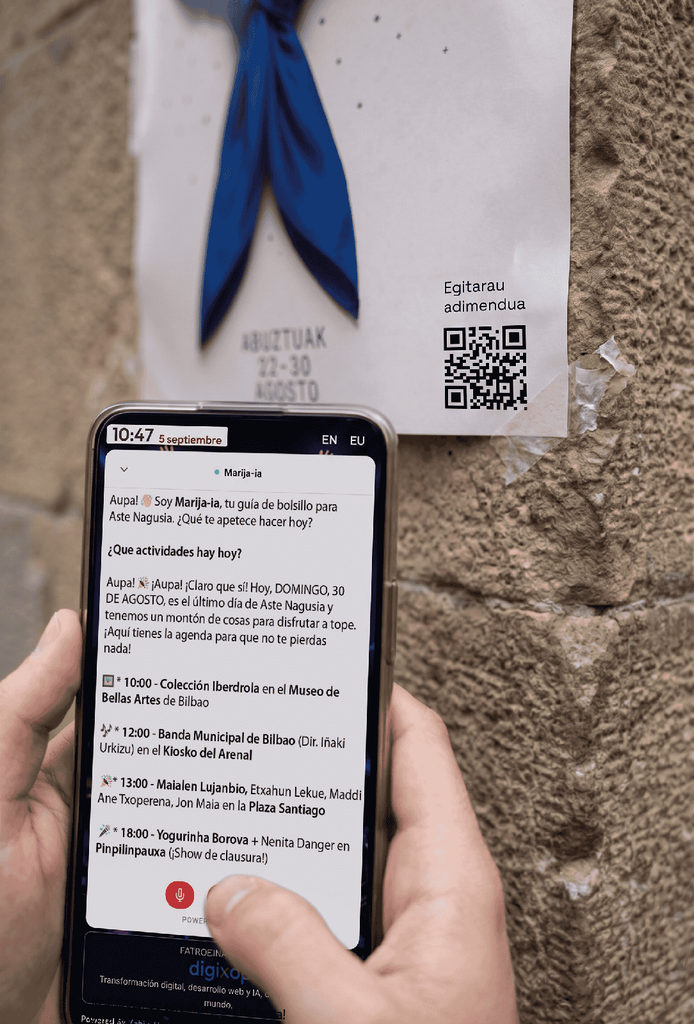
3. Xabia AI accessible online
Xabia Ai can be linked to any website, database, or structured and unstructured file. Similarly, with a small code snippet , it can be embedded in any municipal, institutional, or other type of website . WordPress or a traditional CMS is not required.
Thus, Xabia Ai can have its “agent” Marija-ia operating on the Bilbao municipal website , as well as on the websites of the comparsas, a theater, or the tourist office.
In the case of this year’s test, a very simple landing page was created to showcase Marija-ia and interact with users, and a small campaign on Meta to make it known to visitors of Aste Nagusia.
Xabia Ai, an advertising platform with zero spam and maximum relevance.
Aste Nagusia generates millions of euros in local hospitality, retail, and services. However, traditional advertising at large-scale events is often intrusive or irrelevant.
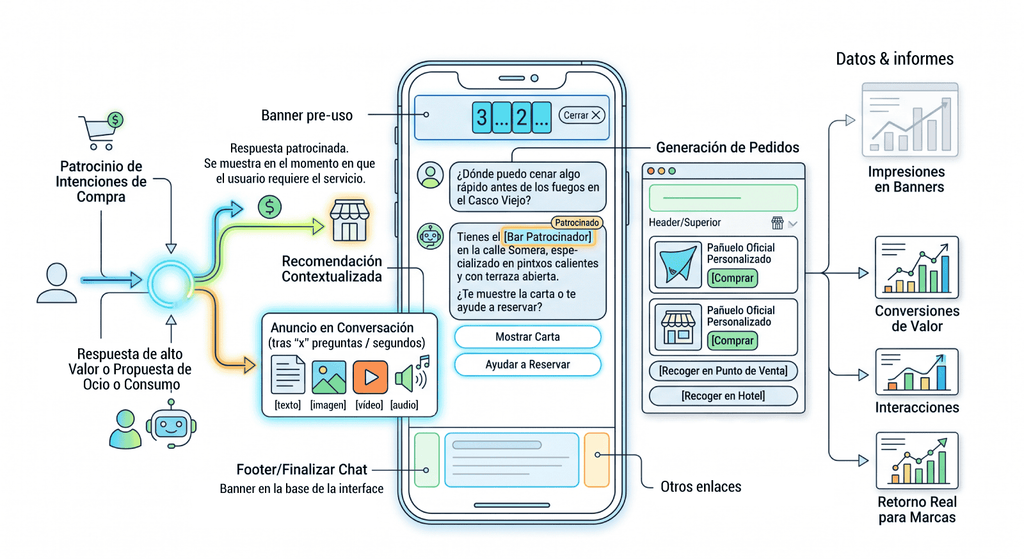
Xabia AI turns the festival program into an engine for economic revitalization and conversational retail :
- Contextualized and non-intrusive recommendation: If a user asks, “Where can I grab a quick bite before the fireworks in the Old Town?” , the system can prioritize verified local sponsor establishments: “There’s [Sponsor Bar] on Somera Street, specializing in hot pintxos and with an open terrace. Would you like me to show you the menu or help you make a reservation?”
- Multiple user touchpoints : Advertising can appear before use, with a timer and a button to close the banner; after use, with an ad upon closing; during the conversation, after “x” questions or “x” seconds of use; it can be included on the assistant’s support page, utilizing the margin, or at the top, or at the end of the chat. It can be text, an image, a video, or an audio message with music.
- Order generation and on-demand merchandising: As we show with e-commerce integrations in museums , visitors can order commemorative products (the official personalized scarf, t-shirts with party motifs or show tickets), and pick them up directly at the points of sale or receive them at their hotel.
- Metrics and real return for brands: Local brands and businesses don’t buy impressions on banners that nobody looks at: they sponsor purchase intentions and high-value responses at the exact moment the user makes the leisure or consumption decision.
Real economic viability: from €1 per conversation to almost zero marginal cost
Until now, deploying a conversational AI assistant for an event with over a million people was a budgetary pipe dream. Conventional AI architectures consume hundreds of thousands of tokens per interaction by sending massive histories to the cloud, placing the average cost at around €0.50–€1.00 per conversation .
Multiplying that cost by hundreds of thousands of inquiries over 9 days is unaffordable for any city council, festival committee, or manager of any mass event.
Xabia AI has broken this barrier for the first time:
- Thanks to its local 2-phase RAG filtering , the data packet that travels to the inference model is microscopic (only the question and the exact 2 fragments of the answer).
- Token consumption is reduced by more than 95%, bringing the cost per conversation down to fractions of a cent. In fact, the more than 5,000 real conversations in this pilot test cost less than a set lunch menu in the Old Town.
- This makes it possible for an entire city to interact with AI in a continuous, massive, and sustainable way.
- Furthermore, to prevent potential malicious attacks or bots from overloading communications or draining our budget, Xabia Ai has total and per-user daily consumption limits that can be easily modified from the superb administration of our little digital brain.
To prove it, Digixop is paying for this round 😉
Privacy and Data Sovereignty
In a massive public environment, privacy is non-negotiable:
- No biometric tracking or cameras: All interaction is based on natural language and ephemeral context.
- Strict GDPR compliance: Data is processed on secure nodes within the European Union (Madrid/Belgium region).
- Protecting local knowledge: Event and sponsor data reside on the client’s infrastructure and are never used to retrain third-party public models. Furthermore, in this case, we worked with publicly available data and did not collect any emails, personal data, or even IP addresses.
If you want to do it at your event, you can do it now!
As you’ve seen, artificial intelligence in public spaces doesn’t need bulky glasses or complex interfaces. True innovation is invisible, accessible, multilingual, and incredibly useful .
- For the users , first and foremost. It speaks their language, it’s up-to-date, and it gives them the information they need with 100% confidence;
- For organizing entities , it’s economical, simple, fast, efficient… a luxury within their reach!
- For advertisers and sponsors , a top-tier platform, aimed at the heart of their target audience.
Transforming the program of the most complex and crowded event into a fluid, personalized conversation capable of revitalizing the local commercial fabric is a small example of what this approach can achieve.
The Xabia AI model offers a new standard for festivals, international fairs, cultural capitals and events worldwide.
Want to see how Marija-ia worked or implement this technology at your next event or institution? Visit xabia.ai/an . ( NOTE : Ask her when the events were, since the party’s over and she’ll obviously tell you there’s nothing.)